Collect membership fees automatically
No more tracking in Excel or sending loose payment requests. Set the membership fee and let Ledenboek collect it — with a clear payment status per member and automatic reminders.
Why collect automatically?
For many treasurers, collecting membership fees is the most tedious chore of the year: keeping a list, sending payment requests, going through bank statements and chasing late payers. In Ledenboek, most of that happens automatically.
You record the amount, send out the invoices or direct debits, and see per member right away whether they have paid. Reminders go out automatically. That leaves you more time for the fun parts of running the association.
Step by step
-
1
Set the membership fee
Record the membership fee per member — or set it in one go for an entire group. Different amounts (for example youth, family or supporting members) can simply exist side by side.
-
2
Connect your payment method
Connect your payment provider for online payments and automatic direct debit, or your accounting software. That way the money goes straight to the association, not to an intermediary.
-
3
Send out the membership fees
Generate the invoices or direct debit orders for all your members in one click. Members pay online via a payment link; with direct debit the amount is collected automatically.
-
4
Track the payments
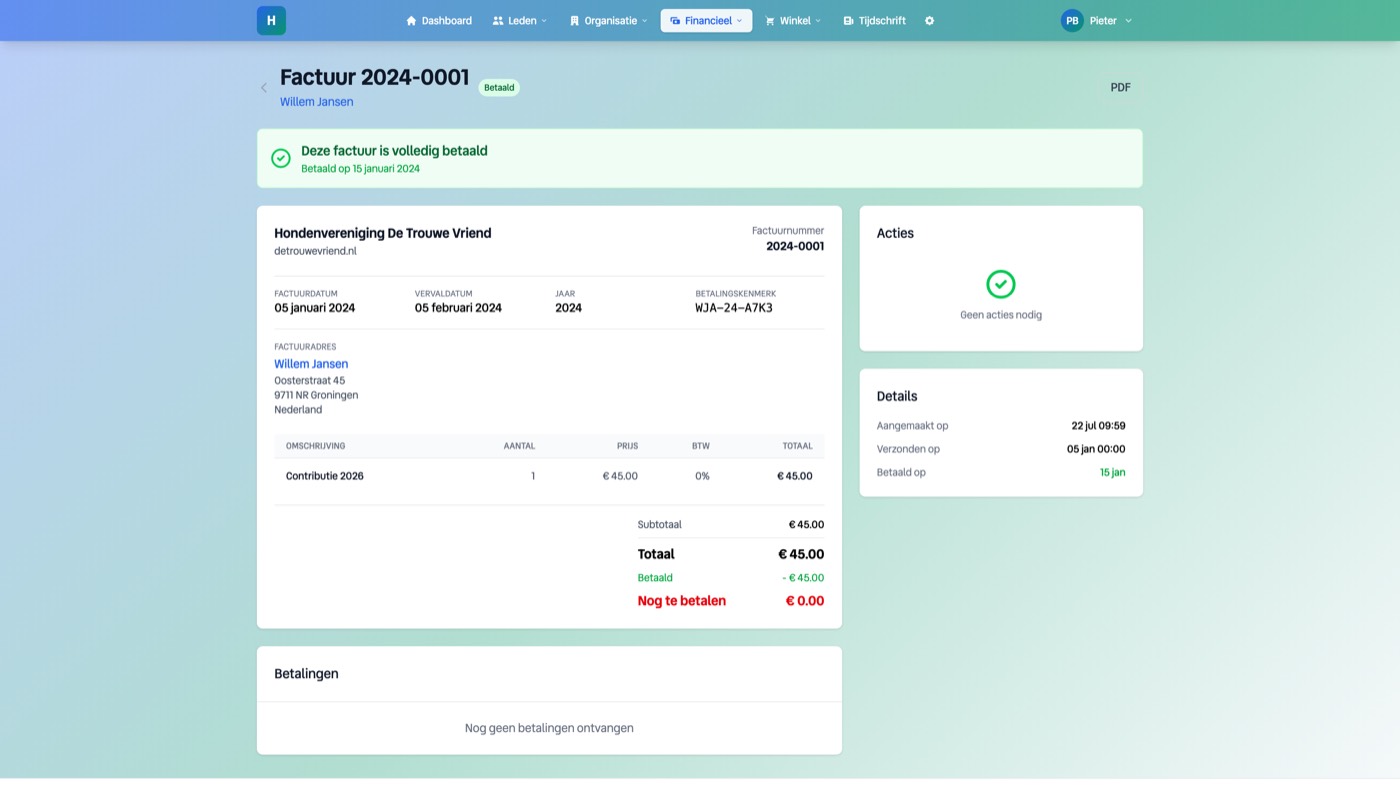
You see per member whether they have paid. Members with outstanding payments automatically receive a reminder, and you can manually mark a payment as paid if it comes in in cash or by bank transfer.
Always in control
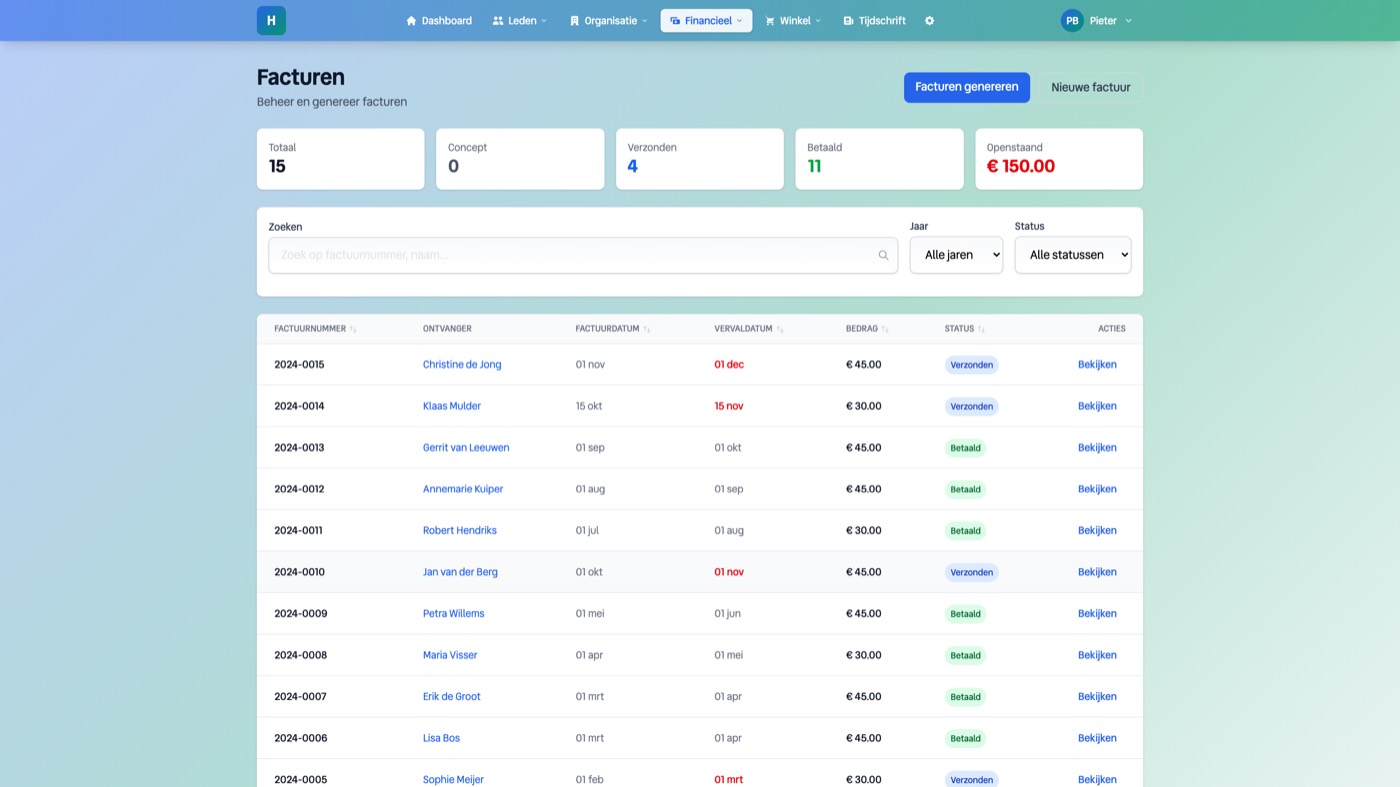
The invoice overview shows you at a glance how much has been sent, paid and is still outstanding. Filter by year or status, and click through to an individual invoice.
Four ways to collect membership dues
Which method fits depends on how many members you have and how often you collect. Most associations use two side by side: one main route and one exception for those who do not fit it.
Direct debit
The money is taken from the member's account on a date you set. This is the cheapest method at larger volumes and the only one where you do not have to chase anyone. It does require two things: a direct debit contract with your bank including your own creditor identifier, and a signed mandate from every member. Without a mandate you may not debit, and the member can reclaim an incorrect debit up to thirteen months later.
Payment request or payment link
The member receives a link and pays themselves by iDEAL or another method. No bank contract needed, no mandate, and the money usually arrives the same day. You pay the payment provider a small amount per transaction. This is the practical choice for small associations and for one-off amounts such as a tournament or a camp week.
Invoice and bank transfer
You send an invoice and the member transfers the amount themselves. Costs nothing in transaction fees, but it does cost time: someone has to track the bank statements and send reminders. Beyond fifty members that adds up quickly. Still the right route for sponsorship contributions and for members unwilling to give a mandate.
Cash
Still occurs at small associations and with junior members. Do record who paid what, otherwise you create exactly the gap the audit committee asks about later. In Ledenboek you settle a cash payment against the invoice, so the member and the administration keep the same picture.
What you need for direct debit
Direct debit is not a button but an arrangement with your bank. Three things have to be in place before the first run.
Apply to your bank for a business direct debit contract. You receive a creditor identifier, a code included in every collection file by which the member sees who the debit is from. At most banks the application takes one to several weeks, so start well before the first collection run.
Obtain a mandate from every member. That can be on paper, but also digitally at sign-up or through a payment where the member gives the mandate themselves. Record per member when the mandate was given and under which reference. In a reversal that is the only thing proving you were allowed to debit.
Announce every debit in advance, with amount and date. Fourteen days is the usual notice period; shorter is allowed if you have agreed that with your members. An announcement reduces reversals: most of them happen because someone sees an unfamiliar debit and takes fright.
Collecting fees by direct debit: via Mollie or via your own bank
Via Mollie, a member gives the mandate themselves, on the payment page of their first invoice. After that, Ledenboek collects the fee automatically on the day it is due. You do not need a creditor identifier from your bank for this.
Via your own bank you do need a creditor identifier, which you request from your bank. Ledenboek then creates a SEPA direct debit file for each collection run with all members who have given a mandate, and you upload it in your online banking. If your bank does not accept an XML file, as in some Rabobank environments, you get the Rabobank debtor list instead.
A member can have a direct debit reversed within eight weeks. Such a reversal appears on your next bank statement; when you import it, the invoice is open again and the treasurer gets a notification.
What to do when a member does not pay
At every association a small share stays outstanding. It pays to have a fixed route for that rather than deciding case by case.
Start with a reminder, not a demand. By far the most outstanding amounts are forgotten rather than refused: a house move, a new bank card, an email in the spam folder. A friendly reminder after fourteen days resolves most of it.
If that does not help, send a formal demand with a clear deadline and state what happens next. Include how someone can get in touch: sometimes there is a payment problem behind it that an arrangement can solve, and then you keep a member instead of a claim.
Record in your articles or internal rules what happens on prolonged non-payment: suspension from participation, exclusion from competition, or termination of membership. Without that you stand weak, and with it the board no longer has to debate it.
Raising the dues
A rise is a decision of the general meeting, unless your articles say otherwise. Announce it well in advance and explain where the money goes; a rise that comes with an explanation rarely draws objection, one that quietly appears on a bank statement does. If you use direct debit, adjust the amount before the next run is prepared, and check whether members on a different rate — juniors, families, honorary members — stay outside the increase if that is the intention.
Outsource collecting membership fees?
Outsourcing collection means handing it to a payment service or collection agency that charges per member or per transaction and then passes the money on. That takes work away, but the records then live in two places: the members with the association and the payments with the service.
In Ledenboek, collection stays with the association without becoming more work. The collection run is built from the member list, and payments come back via Mollie or the bank statement and appear with the member automatically. You then only need a collection agency for a member who still does not pay after the reminders and the formal demand.
Collecting membership fees in Belgium
A Belgian association works in Ledenboek with membership fees (lidgeld) and domiciliation. Every invoice gets a structured communication, and a payment with that communication is matched to the right invoice automatically when you import your bank's CODA file. Members pay online with Bancontact, and a domiciliation runs through the same SEPA file as a direct debit in the Netherlands.
Frequently asked questions
Can I use different amounts per member?
Yes. Each member has their own membership fee amount, so youth, family or supporting members can be set up separately.
Do I have to use direct debit?
No. You can choose automatic direct debit or payment links that members pay online themselves — or a combination.
What if someone pays by bank transfer?
Then you manually mark that invoice as paid, or you link the bank transaction to the invoice. The status is correct again.
Do late payers automatically get a reminder?
Yes, outstanding invoices can automatically receive a reminder, so you don't have to chase anyone.
I changed an amount, why does the invoice not follow?
An invoice is a snapshot of the moment you create it. If you change an amount or a membership afterwards, the invoice stays as it was. To get the new amount, cancel that invoice and prepare the round again; anyone with a correct invoice is skipped.
Can I collect before the due date has passed?
Yes. The due date only says until when someone can transfer the money themselves and is separate from your direct debit. An invoice can be collected as soon as it is outstanding. You choose the collection date per round; it only has to be a working day, at least two working days ahead.
Can I outsource collecting membership fees?
You can, but with Ledenboek it is usually unnecessary. Direct debits and payment links go out from the association itself, and payments are matched to the member automatically. Only a member who does not pay after reminders and a formal demand still needs to be handed to a collection agency.